Last updated 2026-07-25
TL;DR
A nonprofit treasurer tracks the money, keeps the books, files the right IRS Form 990 variant every year, reports finances to the board, and helps set the budget. In a small booster club or PTO, that's often one volunteer wearing all those hats with no accountant backup.
What does a treasurer do, exactly?
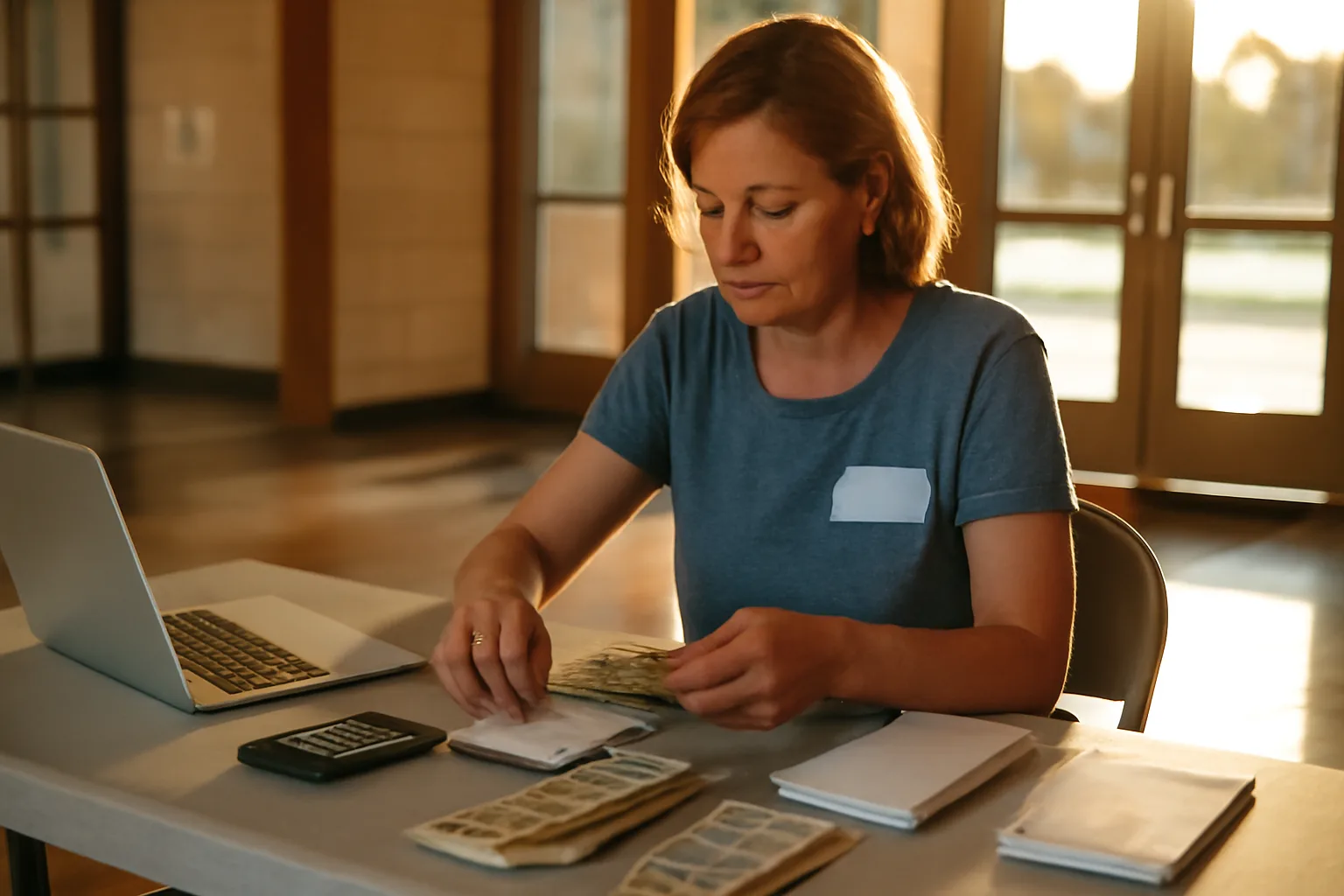
A treasurer is the person a nonprofit board trusts to track every dollar coming in and going out, and to tell the truth about it at every meeting. That's the short version. The long version has a lot of unglamorous parts: reconciling a checking account against receipts, keeping a simple ledger or spreadsheet current, cutting checks or approving reimbursements, and making sure nobody (including the treasurer) can move money without a second set of eyes. In a small volunteer organization, the treasurer usually also does the jobs a bigger nonprofit splits between a bookkeeper, a controller, and a CFO. That's not a knock on volunteers, it's just the reality of a $40,000-a-year booster club budget versus a $4 million nonprofit with paid staff. The core duties break down into four buckets: recordkeeping (every transaction, dated and categorized), reporting (a clear financial picture for the board, monthly or quarterly), compliance (filing the correct IRS form and any state paperwork on time), and controls (rules that stop one person from quietly draining the account). Miss any one of those and the organization is exposed, whether that's to an IRS letter, a board member asking hard questions, or in the worst case, actual theft.
What is a treasurer, and how is the role different from a bookkeeper?
A treasurer is a governance role, usually an officer position named in the bylaws, with fiduciary duty to the organization and its board. A bookkeeper is a task, entering transactions and reconciling accounts. In a lot of booster clubs and PTOs those two things collapse into one unpaid person, but they're conceptually different jobs. The fiduciary piece matters. Officers, including treasurers, generally owe a duty of care and a duty of loyalty to the nonprofit they serve; most state nonprofit corporation statutes spell this out, and it's why a treasurer signing off on numbers they didn't actually check is a real legal exposure, more than sloppy habit. Confirm the specific standard with your state's nonprofit corporation statute, since wording varies. Practically, a treasurer's job includes decisions a pure bookkeeper wouldn't make: recommending a budget, flagging a cash flow problem to the board, deciding whether an expense needs a vote first, and signing (or refusing to sign) the annual Form 990 filing. A bookkeeper feeds the treasurer good numbers. The treasurer is accountable for what happens with them.
What do treasurers do day-to-day, month-to-month, and year-to-year?
| Weekly or as-needed | Deposit funds, log transactions, approve small reimbursements | |
|---|---|---|
| Monthly | Reconcile bank statement, report to the board, pay bills | |
| Quarterly | Review budget-to-actual, check on any state filing deadlines | |
| Annually | Prepare and file the correct 990 variant, present annual budget, support any independent review or audit | |
| At handoff | Transfer records, passwords, and signing authority to the next treasurer | That last row gets skipped constantly and it's usually where things go sideways. A treasurer who leaves without a clean handoff packet (bank access, prior filings, current-year ledger) can cost the next volunteer weeks of untangling, or worse, cause a missed 990 deadline that nobody even knew was coming. |
Day-to-day, a treasurer deposits checks and cash promptly, logs every transaction, and keeps receipts filed (digital or paper, doesn't matter, as long as it's organized). Month-to-month, they reconcile the bank statement against the ledger, prepare a short financial report for the board meeting, and pay any recurring bills. Year-to-year, they build or update the annual budget, close out the fiscal year's books, and handle the big compliance deadline: the IRS filing. Here's a rough cadence for a typical booster club or PTO treasurer: | Frequency | Task |
What is Form 990, and why does a treasurer have to care about it?
Form 990 is the annual information return the IRS requires most tax-exempt organizations to file, and the treasurer is almost always the person responsible for getting it done or handing clean numbers to whoever prepares it. The IRS states plainly that "tax-exempt organizations, nonexempt charitable trusts, and section 527 political organizations file this form to provide the IRS with the information required by section 6033" [1]. There isn't just one 990. Which version an organization files depends on gross receipts and total assets: - Form 990-N (the "e-Postcard"): for organizations with gross receipts normally $50,000 or less [2]
- Form 990-EZ: for organizations with gross receipts under $200,000 and total assets under $500,000 [3]
- Full Form 990: required above those thresholds
- Form 990-PF: for private foundations, regardless of size Most booster clubs, PTOs, and small youth sports nonprofits land in 990-N or 990-EZ territory. But "small" doesn't mean "skip it." The IRS has been explicit: an organization that fails to file for three consecutive years has its exemption automatically revoked, no warning letter required beyond the missed filings themselves [4]. That's a treasurer's problem to prevent, full stop, because rebuilding after revocation means reapplying for exempt status, sometimes retroactively, and it's a much bigger headache than three annual e-Postcards would ever have been.
What is the 990 tax form, in plain terms (and is it actually a tax form)?
Calling it a "990 tax form" is common but a little misleading: for most exempt organizations it's an information return, not a bill. The IRS doesn't calculate income tax owed off a standard Form 990 the way it would off a 1040 or 1120. It's a disclosure document. Revenue, expenses, program activities, board members, and compensation, all reported so the IRS (and anyone else who looks it up) can see how the organization is being run and funded. That said, if a nonprofit has significant income unrelated to its exempt purpose, it might owe Unrelated Business Income Tax (UBIT), reported separately on Form 990-T [5]. A booster club running a modest concession stand at games generally isn't in UBIT territory, but a club running, say, a for-profit-adjacent side business under the nonprofit's roof should ask a tax professional, because that's a real gray area and not something to guess at. Because 990s (all variants except 990-N, which just isn't a full document in the same way) are public record, a treasurer's filing choices are visible to donors, grant funders, and journalists who pull them from the IRS or from sites like ProPublica's Nonprofit Explorer. Sloppy or late 990s are a credibility problem even before they become a compliance problem.
What does a treasurer do in a club, specifically a booster club, PTO, or youth sports league?
In a club setting, the treasurer's job shrinks in scale but not in seriousness. A high school band boosters treasurer might handle $15,000 to $60,000 a year; a youth soccer league treasurer might handle six figures if it covers field rentals, referee pay, and uniforms across multiple age divisions. Either way, the core duties are the same as any nonprofit treasurer, just with fewer layers of staff to catch mistakes. Typical club treasurer duties include: - Opening and maintaining the bank account (and making sure it's not tied to one person's personal Social Security number long-term; an EIN from the IRS is standard practice)
- Collecting dues, concession revenue, and fundraiser proceeds, and depositing them promptly rather than letting cash sit in someone's car
- Tracking spending against a season or school-year budget the board approved
- Reporting numbers at every board or general membership meeting, more than once a year
- Filing the correct 990 variant annually
- Handling any state charitable solicitation registration or raffle licensing paperwork, which varies significantly by state and is worth confirming directly with your state's charity regulator
- Managing the handoff to the next treasurer, ideally with a written procedures document A lot of clubs run into trouble not because the treasurer is dishonest but because there's no second person checking the work. Two-signature checks, a board member reviewing bank statements quarterly, and a written reimbursement policy are cheap insurance against both fraud and honest mistakes.
What does a club treasurer do that a school district or company treasurer doesn't?
A club treasurer, unlike a corporate or school-district treasurer, is almost always an unpaid volunteer with no dedicated finance staff, no internal audit department, and often no formal accounting training. That changes what the job actually requires day to day. A corporate treasurer manages cash flow, banking relationships, and investment of surplus funds, often with a team. A club treasurer is more often the entire finance department: bookkeeper, controller, and compliance officer rolled into one person who also might be coaching a team or running the snack bar between board meetings. The stakes are different too. A club treasurer's biggest legal exposure isn't shareholder lawsuits, it's the organization's tax-exempt status itself. Because so many booster clubs and PTOs are small enough to qualify for 990-N, and because 990-N compliance requires almost no accounting sophistication (it's a handful of data points filed online [2]), the actual failure mode is usually forgetting, not incompetence. Set a calendar reminder well before the filing deadline (the 15th day of the 5th month after the fiscal year ends, per IRS guidance [1]), and that single habit prevents most of the disasters treasurers end up Googling their way out of later.
What financial controls should every treasurer put in place?
Controls are the boring stuff that prevents both fraud and honest mistakes, and every organization, no matter how small, should have some. The IRS itself notes in its guidance for exempt organizations that governing bodies should have policies covering financial oversight, even though it doesn't mandate specific controls for most small nonprofits [6]. At minimum, a treasurer (with board buy-in) should have: - Two signers required on any check above a set dollar threshold
- A written reimbursement policy with receipt requirements
- Monthly bank reconciliation reviewed by someone other than the treasurer
- A rule that the treasurer never has sole, unsupervised access to both the checkbook and the bank statements long-term
- A budget approved by the board before the year starts, with variance reported regularly
- Backup access (a second board member with read access to bank statements) in case the treasurer is unreachable None of this is about distrust. It's about protecting the treasurer as much as the organization; a volunteer with sole control over money and no oversight is the one most likely to get blamed if something looks off later, even if they did nothing wrong. Financial controls built early save real headaches during the annual review or when a new treasurer takes over.
What happens if a treasurer misses a 990 deadline or the organization loses its exempt status?
If an organization fails to file the required 990 variant for three consecutive years, the IRS automatically revokes its tax-exempt status, and the revocation is effective on the original filing due date of the third missed year [4]. There's no appeal process for the automatic revocation itself; the fix is reapplying. Once revoked, the organization shows up on the IRS Tax Exempt Organization Search as revoked, donations may no longer be tax-deductible for donors, and in some states this can also affect charitable registration and even the ability to hold a raffle license. Reinstatement usually means filing Form 1023 or 1023-EZ again, and depending on timing and circumstances, the IRS has a streamlined retroactive reinstatement process for organizations that apply within 15 months of revocation and meet the criteria in Revenue Procedure 2014-11 [7]. Outside that window, or for larger organizations, the process is more involved and worth discussing with a tax professional, since this article isn't tax or legal advice and outcomes vary by case. A treasurer who catches a lapse early, even mid-second-missed-year, can usually just file the missing returns and avoid the whole mess. That's the entire argument for a simple recurring calendar reminder over a spreadsheet nobody checks.
What should a treasurer hand off to the next person?
A clean handoff is where most club treasurer horror stories either happen or get prevented. At minimum, the outgoing treasurer should hand over bank account access and signer changes, the current and prior year's ledger or QuickBooks/spreadsheet file, copies of the last three years of filed 990s, any state registration or raffle license paperwork, the current budget, and a written summary of recurring bills, vendors, and deadlines. A lot of organizations lose this history entirely when a treasurer's kid graduates and the family moves on. The next volunteer starts from zero, sometimes doesn't even know a 990-N was due, and finds out eighteen months later that the exemption is gone. Handoff and audits practices, done once and written down, solve this permanently; it's a one-afternoon project that saves the next three treasurers from guessing. This is exactly the gap the $99 one-time State-Personalized Treasurer Kit at /treasurer-kit-builder is built to close: a state-specific packet covering the filing calendar, handoff checklist, and control templates a new volunteer treasurer actually needs, without paying for a bookkeeper or accountant to build it from scratch.
How much time does the treasurer role actually take?
There's no official government study measuring volunteer treasurer hours, so take this as informed estimate rather than cited statistic: for a small booster club or PTO with a budget under $50,000, expect roughly 2 to 5 hours a month in a quiet month, spiking to 10 to 15 hours during fundraiser season or at fiscal year-end when the 990 filing and annual report are both due. Organizations with more revenue, more bank accounts, or state charitable registration requirements (many states require registration above certain revenue thresholds, and the specifics vary a lot, so confirm with your state's charity office) will run higher. The time cost is one reason boards should never leave the treasurer seat empty or let one person hold it for six years straight with no backup; burnout and knowledge loss both show up eventually.
Frequently asked questions
What does a treasurer do?
A treasurer tracks all money coming into and out of an organization, keeps the books current, reports finances to the board regularly, helps build the annual budget, and makes sure the required IRS filing (usually a 990 variant) gets done on time. In small nonprofits, they often do this alone with no accounting staff behind them.
What is a treasurer?
A treasurer is an officer of an organization, usually named in the bylaws, responsible for its finances and reporting. It's a governance role with fiduciary duty, more than a bookkeeping task, which is why most state nonprofit statutes hold treasurers to a legal standard of care.
What do treasurers do?
Treasurers deposit and track income, pay and log expenses, reconcile bank accounts monthly, present financial reports to the board, build budgets, and file the organization's annual IRS return. They also usually manage the handoff of records when a new treasurer takes over.
What a treasurer does day to day versus once a year?
Day to day: deposits, logging transactions, small reimbursements. Monthly: bank reconciliation and a board report. Annually: budget presentation, year-end close, and filing the correct 990 variant with the IRS by the deadline (the 15th day of the 5th month after fiscal year-end).
What is Form 990?
Form 990 is the annual information return most tax-exempt organizations file with the IRS under section 6033, reporting revenue, expenses, programs, and governance. It's public record, and which version an organization files (990-N, 990-EZ, full 990, or 990-PF) depends on gross receipts and total assets.
What does a treasurer do in a club?
In a booster club, PTO, or league, the treasurer handles dues and fundraiser proceeds, pays vendors like referees or uniform suppliers, reports to the board or membership, files the annual 990, and often manages state raffle or charitable registration paperwork, all usually as an unpaid volunteer.
What does a club treasurer do?
A club treasurer runs the entire finance function solo in most cases: bookkeeping, budgeting, reporting, and compliance, without dedicated staff. The core duties match any nonprofit treasurer, just at smaller dollar amounts and often with less formal training or backup.
What is a 990 tax form?
Despite the common name, it's mostly an information return, not a tax bill; the IRS uses it to see how a tax-exempt organization is funded and run. If the organization owes tax on unrelated business income, that's reported separately on Form 990-T, not the standard 990.
What is the 990?
"The 990" usually refers to Form 990, the IRS's annual reporting form for tax-exempt organizations, though people sometimes use it loosely to mean any variant, including the simpler 990-N e-Postcard for small organizations with gross receipts normally under $50,000.
What does a treasurer of a club do that's different from a corporate treasurer?
A corporate treasurer usually manages cash flow and banking with a team; a club treasurer is typically one unpaid volunteer covering bookkeeping, reporting, and IRS/state compliance alone. The biggest risk for a club treasurer is usually a missed filing deadline, not investment strategy.
How often does a nonprofit treasurer need to file with the IRS?
Annually. Every tax-exempt organization required to file must do so every year by the 15th day of the 5th month after its fiscal year ends. Missing three consecutive years triggers automatic revocation of tax-exempt status under IRS rules, with no separate warning notice required.
Can a treasurer be personally liable for mistakes?
It depends on the state and the mistake. Most state nonprofit corporation statutes hold officers to a duty of care and loyalty, and gross negligence or self-dealing can create personal exposure. Honest mistakes with reasonable oversight generally don't; confirm specifics with your state's nonprofit corporation statute or an attorney.
Does a small booster club really need to file anything with the IRS?
Yes, if it holds tax-exempt status. Even organizations with gross receipts normally under $50,000 must file Form 990-N annually. Skipping it isn't a minor paperwork lapse; three consecutive missed years leads to automatic revocation of exempt status.
Sources
- IRS, About Form 990: Form 990 is filed by tax-exempt organizations to provide information required under section 6033
- IRS, Annual Electronic Filing Requirement for Small Exempt Organizations (Form 990-N): Form 990-N is for organizations with gross receipts normally $50,000 or less
- IRS, Form 990-EZ instructions: Form 990-EZ is for organizations with gross receipts under $200,000 and total assets under $500,000
- IRS, Automatic Revocation of Exemption: Failure to file required returns for three consecutive years results in automatic revocation of tax-exempt status
- IRS, About Form 990-T: Unrelated business income tax is reported separately on Form 990-T
- IRS, Governance and Related Topics for 501(c)(3) Organizations: IRS guidance encourages governing bodies to adopt financial oversight policies
- IRS, Revenue Procedure 2014-11: Streamlined retroactive reinstatement is available for organizations applying within 15 months of automatic revocation